
Copia Deal Space
Senior Product Designer • UX/UI • Web & iOS • 2024-2025
I led UX/UI on Deal Space, an AI-powered Copia product built to support investors and teams through research, analysis, and deal collaboration. Working closely with engineering and our CEO, I helped shape the product from early ideation through delivery.
Evaluating a new deal can get messy quickly. Information lives across pitch decks, financial documents, notes, emails, and stakeholder conversations. Teams need to quickly understand what they’re looking at, identify risks and opportunities, and decide whether an opportunity is worth pursuing. New opportunities are often under tight timelines and with incomplete information. This raised an important question: how do investment teams actually evaluate new opportunities?
I led UX/UI on Deal Space, an AI-powered Copia product built to support investors and teams through research, analysis, and deal collaboration. Working closely with engineering and our CEO, I helped shape the product from early ideation through delivery.
Evaluating a new deal can get messy quickly. Information lives across pitch decks, financial documents, notes, emails, and stakeholder conversations. Teams need to quickly understand what they’re looking at, identify risks and opportunities, and decide whether an opportunity is even worth pursuing. New opportunities are often under tight timelines and with incomplete information too. This raised the question: how could AI help investment teams organize this complexity and help better decision making?


Researching How Investment Teams Evaluate Deals
A big part of the early work involved understanding how investment teams and individuals approached new deal opportunities. Through interviews with investors and members of their teams, I learned how they gathered research, tracked recurring questions, identified risk, and collaborated across documents. Information was often dispersed across people, tools, and files. The evaluation process was rarely linear, with teams constantly shifting between gathering context, assessing fit, and deciding what required deeper attention.
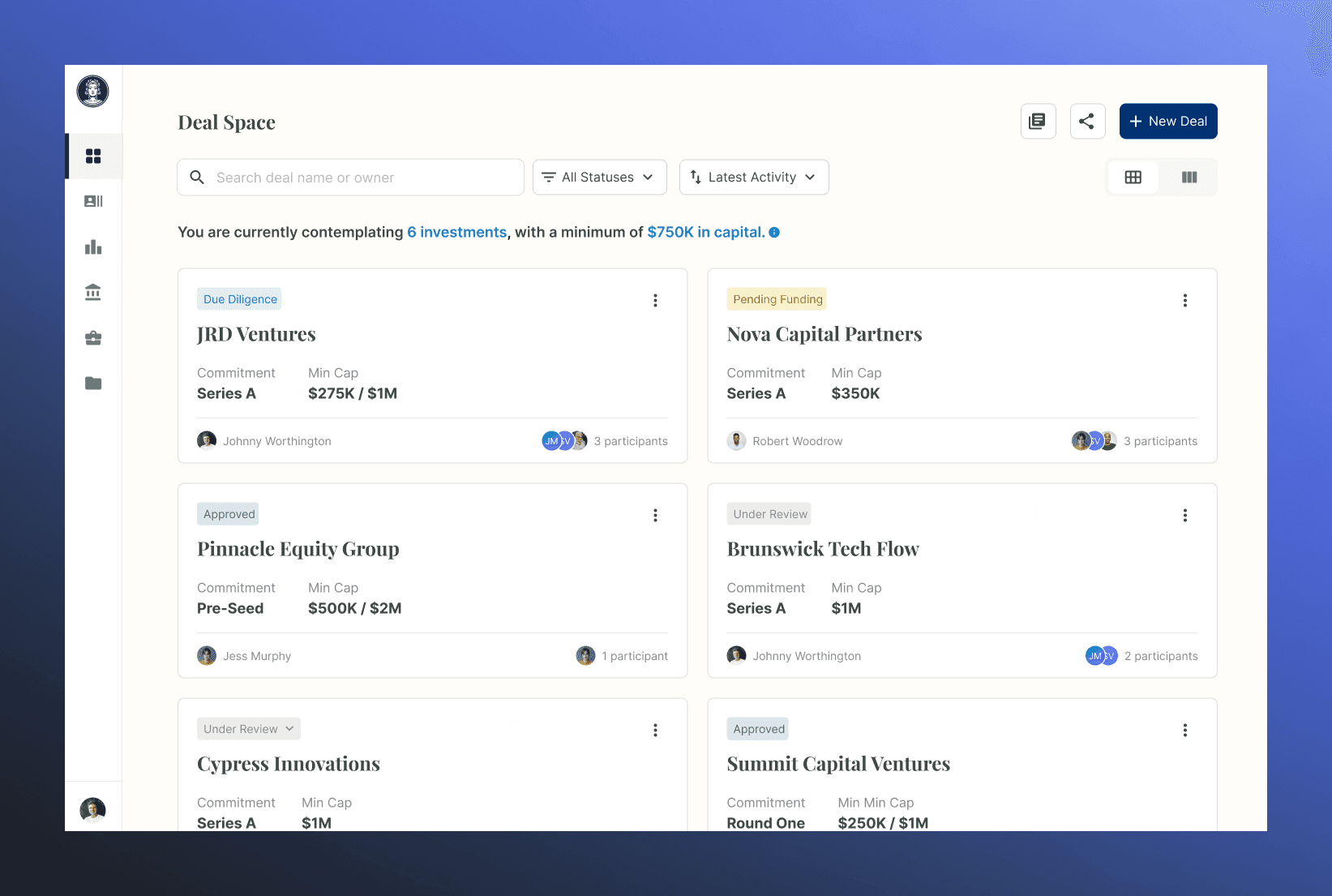
These insights helped me map the real evaluation journey and identify the key stages, decision points, and information needed when reviewing a deal. That research directly informed early product flows and wireframes, including how opportunities were introduced, triaged, and progressed through the system.
The early work on this problem involved understanding how investment teams and individuals approached new deal opportunities. Through interviews with investors and members of their teams, I learned how they gathered research, tracked recurring questions, identified risk, and shared documents. Information was often dispersed across people, tools, and files. The evaluation process was rarely linear, with teams constantly shifting between gathering context, assessing fit, and deciding what might need more attention.
These insights helped me map the real evaluation journey and identify the key stages, decision points, and information needed when reviewing a deal. That research directly informed early product flows and wireframes, including how opportunities were introduced, triaged, and progressed through the system. I explored how new deals might begin through share links and invitations into the system.
Wireframes evolved from simple deal summaries into a more comprehensive deal room that could support team discussions. Learning more about investor workflows, the experience expanded to include knowledge management, commitment tracking, and question templates, reducing the need to jump between multiple tools or documents.


New AI Patterns & Constraints
Designing the AI analysis experience meant navigating new challenges like context windows, token limits, and large knowledge sets. We also had to be thoughtful about introducing AI terminology and interaction patterns our audience might not be familiar with.
A challenge was reducing the time between onboarding and meaningful analysis value. I had to consider designing the moments that helped users understand what the system could do for them. This was achieved through thoughtful UX copy, with an appropriate tone, with repeatable actions and follow up questions.
Executive Summary reports required deep research agents running in the background, which took time. System transparency was an important part of this step. Time indicators were added to help users understand progress and expected wait times. Some friction actually contributed to trust, helping users understand the scale and complexity of the analysis being performed.
Designing the analysis experience meant navigating new AI challenges like context windows, token limits, and large knowledge sets. We also had to be thoughtful about introducing AI terminology and interaction patterns our audience might not be familiar with.
Another challenge was the time between onboarding and getting meaningful value. Generating executive summary reports required deep research time, with agents running in the background, making system transparency an important part of the flow. Interestingly, some friction helped build trust. Rather than expecting instant results, users could see that the system was reviewing documents, conducting research, and working through multiple stages of analysis. This helped the credibility of the output and establish confidence in the recommendations being generated.

Creating a Shared Workspace
The deal room view was designed around a split-screen layout that balanced discussion, context, and analysis. A chat area anchored the experience, while a persistent right-hand panel provided access to deal details, status, knowledge, reports, notes, questions, and supporting documents.
The layout was influenced in part by AI workspace tools like Claude Projects, but adapted to the needs of investment teams. A key design consideration was how AI participated in the experience. All chats, or channels, supported both team discussion and direct AI interaction within the same space. Engineers were able to create listening agents, allowing AI to follow ongoing conversations, retain context, and know when to jump in. Teams could work with AI inside shared discussions throughout the stags of the deal, rather than through separate chats. This reduced context switching and made AI feel like a participant in the process rather than a separate tool.
The deal room view was designed around a split-screen layout that balanced discussion, context, and analysis. A chat area anchored the experience, while a persistent right-hand panel provided access to deal details, status, knowledge, reports, notes, questions, and supporting documents.
The layout was influenced in part by AI workspace tools like Claude Projects, but customized to be a more collaborative space. A key design consideration was how AI participated in the the group chats. All chats, or channels, supported both team discussion with the AI. Engineers were able to create listening agents, allowing AI to follow ongoing conversations, retain context, and know when to jump in. Individuals could also work with AI inside private discussions throughout the stags of the deal.

Building Practical AI Workflows
The product introduced a new set of users to the Copia platform and gave investment teams a more structured way to evaluate opportunities, organize complex deal information, and collaborate across due dilligence. Teams were able to reduce review cycles from weeks to days.
Deal Space gave me hands-on experience designing with emerging AI technologies inside real user workflows. The work strengthened my understanding of AI product design, including how AI can support decision-making and the importance of trust in helping users adopt and feel confident in AI-driven experiences.

